Verification cutoff: August 24, 2026, daily edition.
Executive Summary
Three items clear the bar. MCP’s maintainers have published the protocol’s next roadmap, with agent identity, delegated authority and HTTP transport hardening now explicit priorities; operators should treat that as planning guidance, not as shipped behavior. DuckDB has detailed the parser replacement planned for v2.0 and a concrete breaking change worth finding now: the old x -> ... lambda syntax will become an error unless explicitly enabled. Finally, the Virtual Java User Group has scheduled a free August 27 panel on whether AI has changed software-security response capacity.
Action Queue
1. Add MCP’s identity and transport roadmap to the agent-security checklist
Urgency: This week
Importance: ★★★★☆
What it is: The Model Context Protocol project published an updated roadmap on August 22. Its five priorities are agentic messaging, HTTP-native transport unification and hardening, agent identity and enterprise security, improved primitives, and better SDK ergonomics. The roadmap follows the July 28 specification release but describes work for upcoming releases and beyond.
Why it matters: Agent systems increasingly call tools without a person present. Standardized workload identity, narrower delegation and proof-of-possession would be material improvements over pasted API keys and long-lived tokens, but those roadmap goals do not protect today’s deployments by themselves.
Recommended action: Inventory which workflows use MCP, record the specification and SDK versions they actually run, and keep current authorization, token lifetime, network and audit controls in place. Track identity, DPoP and transport-hardening proposals as they ship; do not implement roadmap prose as if it were a released compatibility contract.
Verified active: August 24, 2026; the official August 22 roadmap and current specification history were checked directly.
Deadline: None; the roadmap covers the next specification release and subsequent work without a fixed release date.
Cost: Free open standard; no regular price applies. Implementation and hosting costs depend on the client, server and infrastructure.
Requirements: An MCP client, server or connector workflow to inventory; familiarity with its current authentication and deployment boundary.
Official source: The New MCP Roadmap
2. Find DuckDB’s old lambda syntax before v2.0 finds it for you
Urgency: This week
Importance: ★★★★☆
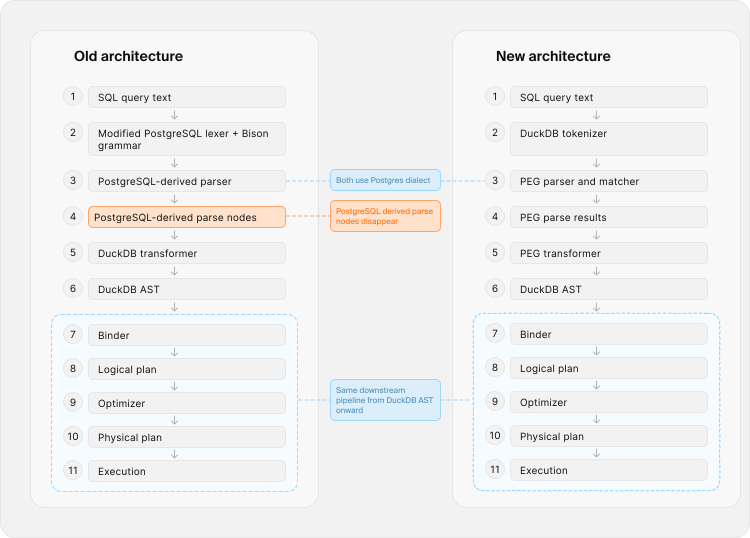
What it is: DuckDB v2.0 is planned to replace the PostgreSQL-derived SQL parser with a PEG-based parser while retaining DuckSQL and the downstream AST pipeline. The project also plans to make the old lambda form, such as x -> x + 1, an error in v2.0 unless a compatibility setting explicitly permits it; v1.5 already warns.
Why it matters: Parser replacements are exactly where old notebooks, classroom examples and small data scripts deserve regression tests. The documented lambda change provides a cheap migration check before a future upgrade.
Recommended action: Search DuckDB SQL, notebooks and examples for -> lambdas, convert them to lambda x : ..., and run representative queries with the opt-in PEG parser in v1.5 before adopting v2.0. Treat the parser-extension API as preview and avoid depending on it yet.
Verified active: August 24, 2026; DuckDB’s August 20 engineering post and August 2026 roadmap were checked directly.
Deadline: Before adopting DuckDB v2.0; no final v2.0 release date is stated and roadmap items can change.
Cost: DuckDB is free, open-source software under the MIT license; no regular software price applies.
Requirements: Existing DuckDB SQL, notebooks or applications; DuckDB v1.5 is sufficient for opt-in parser testing and deprecation warnings.
Official sources: DuckDB v2.0 parser architecture · DuckDB development roadmap
3. Save the free vJUG software-security panel
Urgency: This week
Importance: ★★★☆☆
What it is: The Virtual Java User Group scheduled “Did AI Just Break Software Security Forever?” for Thursday, August 27. The panel brings together practitioners from Java tooling, dependency security and software companies to discuss AI-accelerated vulnerability discovery and response.
Why it matters: The topic is useful for Java and Kotlin teaching because it connects AI capability claims to familiar software-supply-chain and secure-development decisions rather than treating AI security as an abstract future problem.
Recommended action: Save the official livestream and sample the opening 15 minutes live or on replay. Keep only concrete examples suitable for a beginning-student discussion; treat vendor claims as leads until verified.
Verified active: August 24, 2026; the vJUG announcement and scheduled official livestream were checked directly.
Deadline: Live on August 27, 2026, scheduled for 11:00 a.m. Pacific / 1:00 p.m. Central; replay availability is not guaranteed.
Cost: Free livestream; no regular price applies and no certificate is advertised.
Requirements: A web browser and YouTube access; no software installation is required.
Official livestream: Did AI Just Break Software Security Forever?
Free Software
DuckDB remains free and open source under the MIT license. The noteworthy development is migration preparation for its planned v2.0 parser, not a claim that v2.0 is already the stable download; see Action 2.
Free Courses & Certifications
The vJUG panel is a free professional-development livestream, not a course or certification. It is scheduled for August 27; see Action 3.
AI
MCP’s new roadmap makes agent identity and delegated authority first-class protocol priorities. That is strategically important, but current systems still need explicit least privilege, short-lived credentials and auditable tool boundaries; see Action 1.
Open Source
MCP and DuckDB both published unusually useful upstream planning material: one identifies protocol priorities, and the other documents a major internal replacement plus a user-visible deprecation. Neither roadmap should be mistaken for a release guarantee.
Web Development
MCP’s proposed progressive tool discovery addresses a practical agent-integration problem: exposing hundreds of tools consumes context and can reduce tool-selection quality. It remains roadmap work, so current clients still need deliberate tool-surface design.
Linux & Self-Hosting
Self-hosted MCP servers should be treated as authenticated HTTP workloads with explicit trust boundaries. The future identity roadmap does not remove today’s need to inventory tokens, network exposure and server privileges.
Newsletter Highlights
TLDR surfaced the MCP roadmap, TLDR Data surfaced DuckDB’s parser work, and the Virtual Java User Group supplied the August 27 event lead. Consequential details were verified against the MCP and DuckDB projects and the official livestream.
PKb Candidates
- Roadmap versus release: distinguish desired protocol direction, accepted specification work and behavior implemented by the exact SDK version in production.
- Parser-migration checklist: search deprecated syntax, exercise malformed inputs, compare AST-visible behavior and preserve rollback before changing parsers.
- Agent identity boundary: record the human principal, workload identity, delegated scope, credential lifetime and audit trail for every unattended tool call.
Trends Worth Watching
Agent infrastructure is moving from user-approved browser flows toward workload identity and delegated authority. At the same time, mature open-source projects are replacing foundational internals while publishing migration signals early. Both trends reward version-aware operations over headline-driven adoption.
Related PTIR Coverage
- Daily Briefing — August 25, 2026 — CISA risk-based patching, AI-assisted grading and restore-verified database backups.
- Daily Briefing — August 23, 2026 — open-source security funding, local-LLM serving choices and GitHub publishing continuity.
- Morning Briefing — August 22, 2026 — Rust supply-chain cleanup, the August 31 Codex model retirement and accessibility verification.
Sources Consulted
The MCP project roadmap and specification history; DuckDB’s engineering post, development roadmap and project licensing; the Virtual Java User Group announcement and official livestream; TLDR, TLDR Data and other technology-newsletter leads; the maintained OPML source roster; the previous PTIR; and read-only legacy-recipient, Spam and Trash searches. DuckDB’s official parser-architecture diagram was selected as the single explanatory visual.