Verification cutoff: August 11, 2026, evening edition.
Executive Summary
Spend the evening’s 10–15 minutes on one contained local-model test and one repository-governance check. GitHub Copilot for JetBrains can now use Ollama and retain cross-session memories; both capabilities deserve deliberate settings and a non-sensitive trial. GitHub also added a guided conversion from classic branch protection to repository rulesets. A recovered ISC2 lead is worth the ICYMI exception: a genuinely free August 19 security-industry orientation for newcomers.
Action Queue
1. Test Ollama in Copilot for JetBrains—and decide whether memory belongs on
Urgency: This week
Importance: ★★★★★
What it is: The latest GitHub Copilot plugin for JetBrains adds Ollama as a bring-your-own-key provider and persistent Copilot memory across sessions. The same release expands Codex workflows and can install the Copilot CLI through JetBrains terminals on macOS, Linux, and Windows.
Why it matters: This creates a practical bridge between a familiar Kotlin/JetBrains teaching environment and locally served models. It also creates a new persistence surface: useful remembered context can become unwanted retention if nobody has decided what the assistant should store.
Recommended action: Update the plugin, open the Copilot settings portal, and explicitly review the memory toggle before using the feature. Then connect Ollama to a modest local model and run one non-sensitive Kotlin task. Record latency, answer quality, hardware use, and any network activity; do not infer that selecting a local provider makes every part of the Copilot workflow local. If Copilot usage reporting is available, inspect the new per-model token breakdown after the test.
Verified active: August 11, 2026; GitHub’s release announcement and settings were rechecked.
Deadline: No announced deadline.
Cost: Ollama is genuinely free and open source; model weights and licenses vary. GitHub Copilot access is still required and is governed by the user’s existing Copilot plan; GitHub states no separate Ollama-provider price in this announcement.
Requirements: A supported JetBrains IDE, the latest GitHub Copilot plugin, Copilot access, a local Ollama installation and model, and sufficient RAM/VRAM for that model.
Official action link: GitHub Copilot for JetBrains release notes
2. Convert one noncritical repository from branch protection to rulesets
Urgency: This week
Importance: ★★★★☆
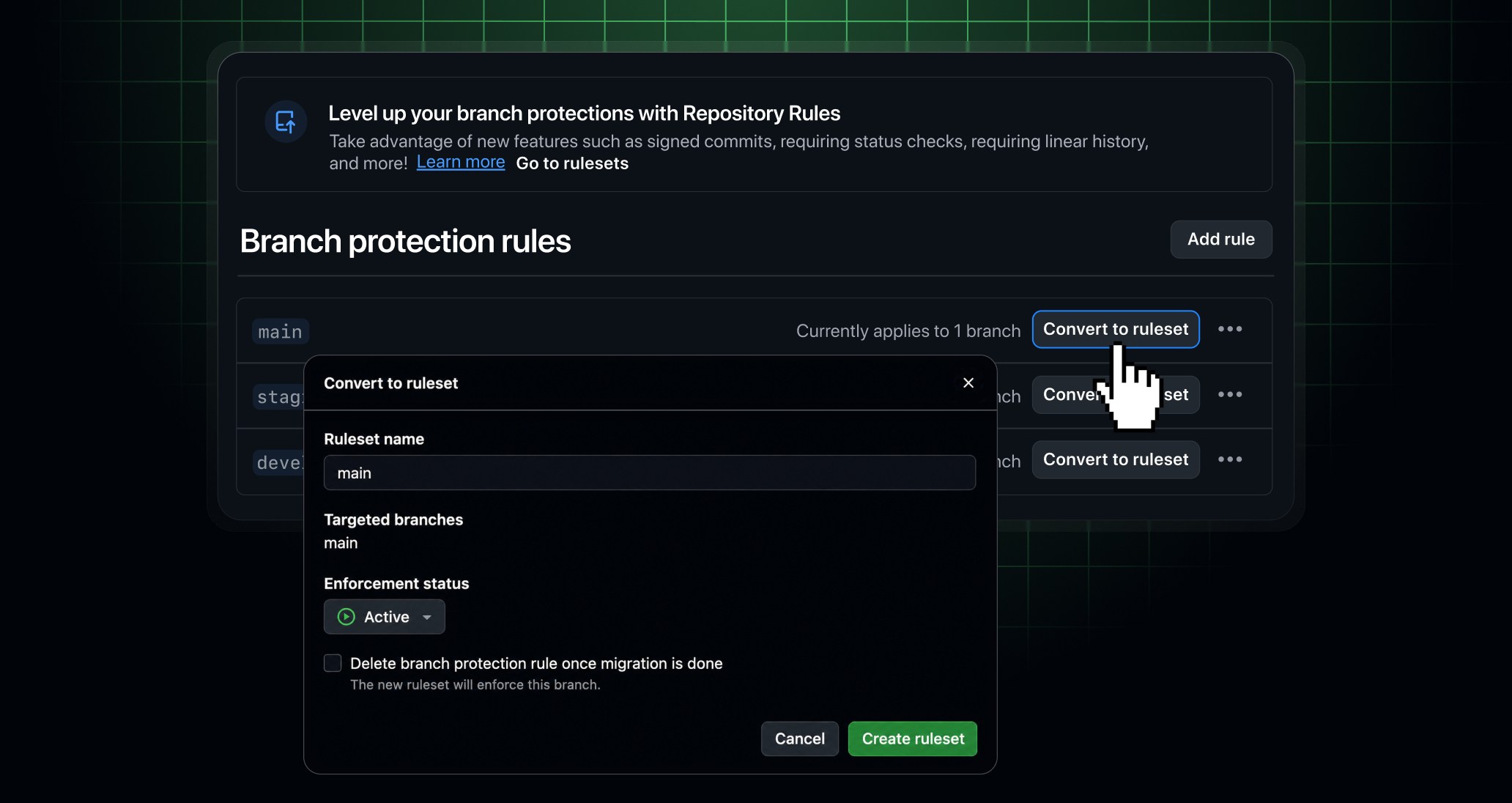
What it is: GitHub now offers an automatic branch-protection-to-ruleset conversion. It maps required reviews, status checks, and push restrictions into a ruleset, which can use patterns, layering, organization management, and finer bypass controls.
Why it matters: Anyone maintaining several public sites and teaching repositories can reduce inconsistent protection settings, but an automatic mapping still needs review before it guards the default branch.
Recommended action: Choose one noncritical public repository. Capture the current classic rule, use Settings → Branches → Convert to ruleset, and compare every mapped review, check, restriction, and bypass before saving. Test a documentation-only change and a failed required check before considering the same migration for higher-value repositories.
Verified active: August 11, 2026; GitHub’s conversion workflow and mapped protections were rechecked.
Deadline: No deadline; classic rules were not announced as deprecated.
Cost: No separate conversion charge is stated. Ruleset availability depends on the repository visibility and GitHub plan.
Requirements: Repository administrator access and an existing classic branch-protection rule.
Official action link: GitHub’s migration instructions
3. ICYMI: Register for ISC2’s beginner security-industry briefing
Urgency: This week
Importance: ★★★★☆
What it is: ISC2’s complimentary Security Briefings series lists Security Industry 101: A Crash Course for New and Aspiring Security Professionals for August 19, 2026, at 1:00 p.m. Eastern / noon Central.
Why it matters: It is unusually well matched to beginning cybersecurity students and career changers: a short, vendor-neutral orientation can provide a shared vocabulary before deeper technical labs or certification planning.
Recommended action: Register through ISC2, then save three questions for evaluation: which entry-level roles are actually described, which skills are demonstrated rather than asserted, and which next step is free rather than a paid certification funnel.
Verified active: August 11, 2026; the event was recovered as a discovery lead and independently checked against ISC2’s official webinar page.
Deadline: August 19, 2026, noon Central; register earlier in case the webinar platform limits attendance.
Cost: Genuinely free for ISC2 members and non-members. ISC2 says its Security Briefings can award one CPE per hour; automatic credit requires the appropriate ISC2 member details. This is not a certification or completion badge.
Requirements: Webinar registration and a BrightTALK account; ISC2 membership is not required to attend.
Official enrollment link: ISC2 Security Briefings
Free Software
Ollama is genuinely free and open source. Its usefulness in the new JetBrains workflow depends on the selected model’s license, local hardware capacity, and the boundaries of the surrounding Copilot integration.
Free Courses & Certifications
ISC2’s August 19 Security Industry 101 briefing is genuinely free for members and non-members. It is professional-development instruction, not a free certification; ISC2 states that eligible briefings can provide CPE credit.
AI
GitHub’s JetBrains update puts three controls in the same workflow: local model selection through Ollama, cross-session memory, and expanded agent/Codex behavior. Evaluate them separately. A local model changes inference placement; it does not automatically define retention, tool permissions, telemetry, or the trust boundary of the IDE plugin.
Open Source
Ollama supplies the open-source local-serving layer in the leading item. Verify the license of each downloaded model independently; a free download is not evidence of open-source training, unrestricted redistribution, or permission for every commercial use.
GitHub Discoveries
The branch-protection converter is the most immediately useful repository feature. GitHub also added per-model input, output, cache-read, and cache-write token detail to Copilot usage reports, making model comparisons less dependent on a single aggregate credit number.
Web Development
Repository rulesets can make required builds and deployment checks more consistent across static sites and web applications. Start with a low-risk repository because bypass behavior and pattern matching are exactly the settings that can quietly weaken—or unexpectedly block—a release.
Linux & Self-Hosting
Ollama remains the relevant self-hosted component. For an honest privacy test, observe outbound connections from the IDE and plugin as well as the local Ollama process; “local model” describes one component, not necessarily the whole workflow.
Newsletter Highlights
ICYMI: An ISC2 webinar digest recovered during the controlled Trash pass surfaced the August 19 beginner-security briefing. The message was treated only as a lead; date, cost, audience, access requirements, and CPE language were checked against ISC2’s official site.
Teaching Corner
Use the Copilot update for a short structured discussion: ask students to draw four boxes—IDE, plugin, local model server, and remote service—and label what code, prompts, memories, tokens, and tool permissions might cross each boundary. This is a compact discussion prompt, not a standalone lab; no separate canonical teaching post is warranted.
PKb Candidates
- “Local model” describes inference placement, not the entire application’s privacy boundary.
- Persistent assistant memory needs an explicit retention and deletion policy.
- Repository-policy migration should be tested for both enforcement and bypass behavior.
- Free professional development, free certification, and CPE eligibility are different claims.
- Token accounting by model makes AI quality/cost experiments reproducible.
Trends Worth Watching
Developer tools are making local inference easier while adding more persistent context and autonomous workflow features. At the same time, repository governance is becoming more composable. The useful pattern is controlled adoption: explicit memory settings, measured local-model tests, and policy migrations first exercised on low-risk repositories.
Related PTIR Coverage
- Morning Briefing — August 12, 2026 — Claude watermark evidence and Cloudflare’s H1 DDoS measurements.
- Morning Briefing — August 11, 2026 — a critical Metabase patch and two local-model evaluations.
- Evening Briefing — August 10, 2026 — Claude Code Auto mode boundaries and a free Codex workshop.
- Morning Briefing — August 10, 2026 — Fedora drive-health monitoring and contained agent-tool evaluation.
Sources Consulted
GitHub’s official changelog posts for Copilot in JetBrains, per-model usage reporting, and ruleset migration; Ollama’s official download information; ISC2’s official Security Briefings page; and a controlled read-only Gmail newsletter, legacy-recipient, Spam, and Trash pass. No unchanged item from the morning edition was repeated.