PTIR — Daily Briefing — November 27, 2026
by
Executive Summary
Two items earn attention today. The open-source whichllm utility turns local-model selection into a hardware-aware, evidence-graded recommendation instead of a guess based only on parameter count. Separately, Canonical has completed its four-exam SysAdmin track, with performance-based Ubuntu tasks making up most of the assessment.
Action Queue
1. Run whichllm once before downloading another local model
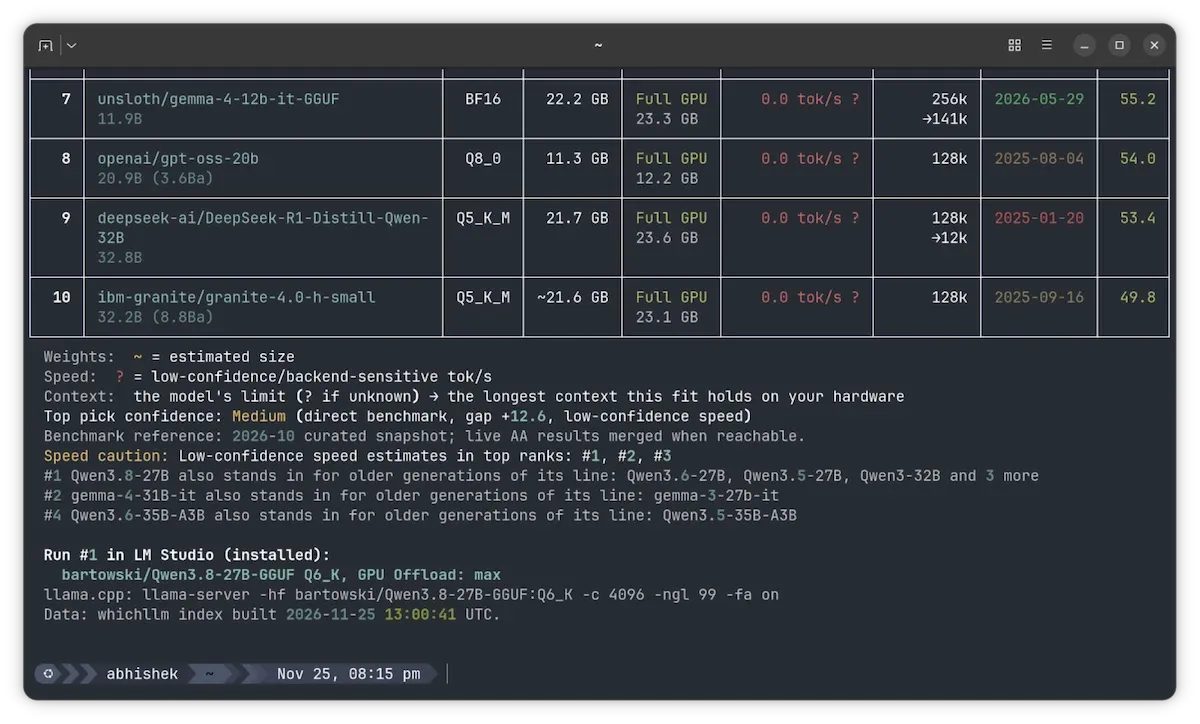
whichllm detects GPU, RAM, and memory bandwidth; estimates model fit and speed; and ranks current open models using benchmark evidence whose confidence is exposed rather than hidden. Its authors explicitly describe speed as an estimate, provide regression tests across hardware archetypes, and let users restrict results to stronger evidence.
- Action: Run
uvx whichllm@latest --evidence stricton one local-AI machine, save the hardware summary and top five recommendations, then compare the first recommendation with an actual llama.cpp or Ollama run before trusting the estimate. - Urgency: This week
- Importance: ★★★★☆
- Verified active: November 27, 2026
- Deadline: None
- Cost: Free and open source under the MIT license; no regular paid price
- Requirements: Python 3.11+ and
uvfor the one-command route; NVIDIA, AMD, Apple Silicon, and CPU-only detection are supported, with model downloads requiring storage and network access - Official repository and installation: Andyyyy64/whichllm
2. Compare Canonical’s SysAdmin track with an existing Linux credential plan
Canonical’s finished track combines four exams: Linux Terminal, Ubuntu Desktop, Ubuntu Server, and DevOps Principles. Most scoring comes from live-system tasks, official documentation and man pages are allowed, and all four passes produce a SysAdmin qualification plus individual badges.
- Action: Read the four exam domains and compare them against an existing Linux+ or Security+ plan before buying anything; use the gap analysis to decide whether Ubuntu-specific hands-on validation adds enough value.
- Urgency: No deadline
- Importance: ★★★★☆
- Verified active: November 27, 2026
- Deadline: None for the qualification; the official launch article mentions a limited promotion, but this report does not treat the discount as the reason to enroll
- Cost: Paid; Canonical’s public overview did not expose a verifiable regular price without entering the Academy purchase flow, so confirm the current total before purchase
- Requirements: No prerequisite course; four online exams, each 60–90 minutes; AI-assisted proctoring with a human in the loop
- Official overview: Canonical Academy SysAdmin track
- Official enrollment page: Canonical Academy
Free Software
whichllm is a useful planning tool precisely because it does not claim to benchmark the current machine merely by estimating speed. It labels weaker evidence, accounts for weights, KV cache, runtime overhead, unified versus discrete memory, and mixture-of-experts placement, and provides a local bench command for reality checks.
Linux & Self-Hosting
Canonical’s certification design is worth studying even without enrolling. Performance-based tasks include systemd services, SSH, firewalls, storage, networking, Ansible, cloud-init, containers, virtual machines, and diagnostic tools. That domain list can double as a practical Ubuntu administration study map.
GitHub Discoveries
The whichllm repository publishes its scoring model, hardware assumptions, regression fixtures, and top-pick changes. That transparency makes it easier to challenge a recommendation than an opaque “best model for your GPU” web form.
PKb Candidates
Local-model selection record: Preserve detected hardware, context length, quantization, evidence grade, estimated speed range, benchmark snapshot date, disk requirement, and measured tokens per second.
Certification gap analysis: Map an exam’s live tasks against existing credentials, current teaching needs, and missing operational practice before purchasing a new badge.
Trends Worth Watching
Local-AI tooling is moving from “what fits in VRAM?” toward workload-aware recommendations that account for partial offload, mixture-of-experts behavior, evidence freshness, and measured-versus-estimated performance. The more useful tools expose uncertainty rather than hiding it.
tags: linux - local-llms - open-source - professional-development - ubuntu - certification