PTIR — Daily Briefing — November 23, 2026
by
Executive Summary
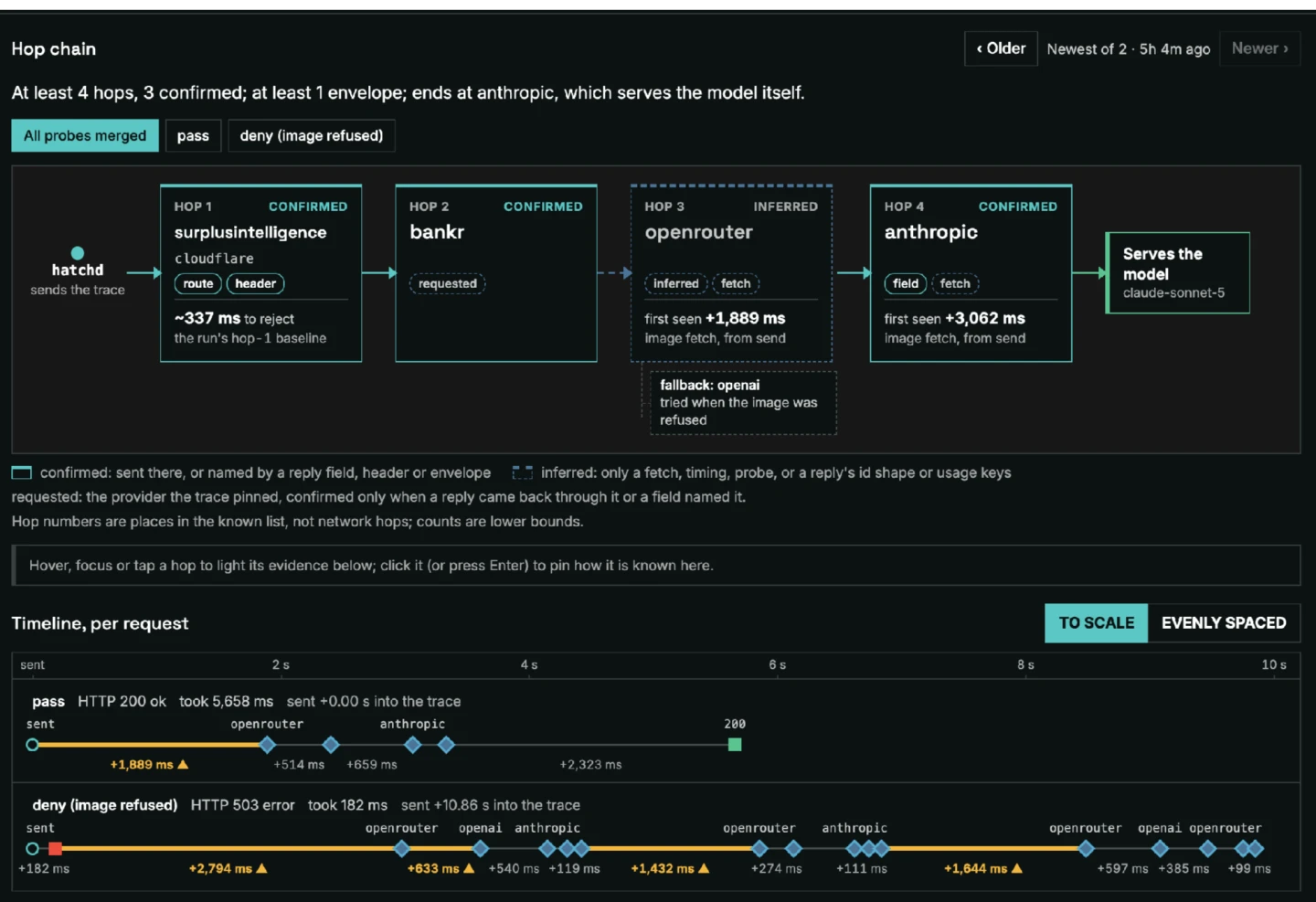
Two developments deserve attention today. Lean and Mathlib’s official communities say they have verified Levent Alpöge’s 17-million-line formal proof of the Riemann Hypothesis through four distinct checks, including independent proof kernels. Separately, Dragos found prompt theft, provider compromise, and ignored privacy settings after tracing nearly two million canary-seeded requests through the AI inference supply chain; OpenRouter responded by removing three providers and stripping 125 endpoints of Zero Data Retention eligibility.
Action Queue
1. Review every routed-LLM workflow for secrets and hidden upstreams
Dragos’s five-month experiment shows that a router’s privacy flag may govern only the first visible hop. OpenRouter’s November 22 incident update says it found no breach of its own systems, but it off-boarded three upstream providers, removed 125 endpoints from Zero Data Retention eligibility, and notified affected customers.
- Action: Check whether any current AI workflow sends credentials, private code, unpublished documents, or personal data through a router or reseller. Prefer a named first-tier provider or local inference for sensitive work; rotate any still-valid secret that appeared in a notified or affected request.
- Urgency: Immediate if notified or if secrets were submitted; otherwise this week
- Importance: ★★★★★
- Verified active: November 23, 2026
- Deadline: None published
- Cost: Reading the incident reports and changing routing policy are free; provider and local-inference costs vary, with no verified regular price
- Requirements: An inventory of AI clients, routers, upstream providers, privacy settings, and secrets that may have entered prompts
- Official research: Dragos: Three breaches, endless leaks
- Provider response: OpenRouter: Data Processing Incidents on Inference Providers
2. Read the Lean community’s verification record—not just the headline
The Lean FRO and Mathlib Initiative report four separate checks: Mathlib experts vetted the formal statement; dozens reproduced the build; two comparison tools confirmed the submission proves exactly Mathlib’s Riemann Hypothesis statement; and Lean’s kernel plus independent checkers accepted an inert proof export.
- Action: Read the short joint statement and save its four-check framework as a reusable test for strong verification claims.
- Urgency: This week
- Importance: ★★★★★
- Verified active: November 23, 2026
- Deadline: None
- Cost: Free
- Requirements: A web browser; compiling the full 17-million-line library is not required and demands substantial compute
- Official statement: Lean verification of the Riemann Hypothesis
- Verification repository: leanprover-community/riemann-hypothesis
AI
The Riemann Hypothesis development is a landmark AI-assisted artifact, but the most transferable lesson is epistemic discipline: “AI helped produce code” is not the verification. The evidence is a chain from a carefully defined theorem to reproducible builds, statement comparison, and multiple proof kernels.
The Dragos findings point in the opposite direction: a privacy label is not proof of the actual data path. Sensitive inference requires an explicit trust boundary, known processors, and a plan for detecting or limiting disclosure.
Open Source
The public Lean repository now separates the theorem statement from the solution, checks that only expected axioms are used, and documents how to compare inert proof exports. That makes the verification process inspectable even for readers who cannot rebuild the entire archive.
Teaching Corner
Four Checks Before Trusting a Formal Proof turns the Lean community’s verification record into a beginner-friendly evidence table: intended statement, reproducible build, statement matching, and independent checking.
PKb Candidates
Verification-chain template: Record the intended claim, executable artifact, exact link between claim and artifact, independent checker, and residual assumptions.
AI data-path inventory: For each AI workflow, record the client, router, every permitted upstream, retention promise, secret-filtering controls, and incident-response owner.
Trends Worth Watching
AI trust is splitting into two complementary disciplines: verifiable outputs and verifiable data paths. Formal methods can make an artifact unusually inspectable, while distributed inference can make the route taken by ordinary prompts surprisingly opaque.
tags: ai - cybersecurity - formal-verification - lean - mathlib - open-source - teaching