Verification cutoff: September 3, 2026, daily edition.
Executive Summary
CISA added CVE-2026-82329 to its Known Exploited Vulnerabilities Catalog on September 2. The critical JFrog Artifactory flaw can let an unauthenticated network attacker obtain administrative privileges under default configuration. JFrog Cloud has already been fortified, but operators of self-hosted Artifactory must upgrade to a fixed release and treat unexpected administrative access as a possible software-supply-chain incident. Separately, Wasmi 2.0 is a worthwhile technical read for its redesigned WebAssembly interpreter, stable fuel metering and deterministic-profile support.
Action Queue
1. Patch self-hosted JFrog Artifactory and review administrative activity
Urgency: Immediate
Importance: ★★★★★
What it is: CVE-2026-82329 is a critical improper-authentication vulnerability disclosed by JFrog on August 28. Under default configuration, an unauthenticated attacker with network access may obtain Artifactory administrative privileges. CISA added it to the KEV Catalog on September 2 based on evidence of active exploitation.
Why it matters: Artifactory can sit inside the software supply chain, storing packages, containers, build outputs and deployment artifacts. Administrative compromise therefore raises questions beyond the server itself: accounts, tokens, federation relationships and artifact integrity may all require review.
Recommended action: Determine whether any environment under your authority uses self-hosted Artifactory. If it does, identify the release branch and upgrade to JFrog’s corresponding fixed version: 7.111.21, 7.117.28, 7.125.20, 7.133.29, 7.146.38 or 7.161.20. Restrict network exposure while the upgrade is pending. Review newly created or changed administrators, access tokens, users, groups, federation settings and recent artifact changes. Preserve evidence and involve incident response if administrative activity cannot be explained. JFrog says its cloud environments are already fortified.
Verified active: September 3, 2026; JFrog’s official advisory and CISA’s September 2 KEV entry were checked.
Deadline: September 5, 2026, for U.S. federal civilian agencies; other operators should act immediately because exploitation is confirmed.
Cost: JFrog publishes the security update for customers without a separate patch charge. Artifactory is commercial software with edition- and deployment-dependent pricing; no universal regular price applies.
Requirements: A self-hosted JFrog Artifactory deployment, administrator and maintenance access, a tested backup, the fixed release for the installed branch and incident-response support if suspicious activity appears.
Official action: JFrog Security Advisories · CISA September 2 KEV notice · CISA KEV Catalog
2. Save Wasmi 2.0 as a reference for constrained WebAssembly runtimes
Urgency: No deadline
Importance: ★★★☆☆
What it is: Wasmi 2.0 is a production-ready Rust WebAssembly interpreter aimed at embedded devices, plugin systems, cloud hosts and smart-contract execution. The project reports about 2.2-times the geometric-mean execution performance of Wasmi 1.0 on its benchmark suite using an Apple M2 Pro. The release also adds stable fuel metering, WebAssembly deterministic-profile support, a smaller-build option and an improved CLI.
Why it matters: The engineering write-up is useful beyond this specific crate. It explains direct- and indirect-threaded dispatch, accumulator registers and the tradeoff between interpreter speed, memory use and platform portability—good material for Linux, Rust, self-hosting and systems-teaching notes.
Recommended action: Save the release article rather than immediately replacing a runtime. If a project already embeds Wasmi, reproduce the vendor benchmark with the project’s own modules, startup pattern, memory limit and target hardware. Review migration notes and tests before adopting a major release. For a teaching demonstration, compare switch-loop and threaded dispatch conceptually without requiring students to optimize unsafe code.
Verified active: September 3, 2026; the Wasmi Labs release article, source repository and package listing were checked.
Deadline: None.
Cost: Free and open source under the MIT or Apache-2.0 license; no regular price.
Requirements: Reading requires none. Evaluation requires a Rust toolchain, representative WebAssembly modules and target hardware.
Official action: Wasmi 2.0 engineering and release article · Wasmi source repository · Wasmi package
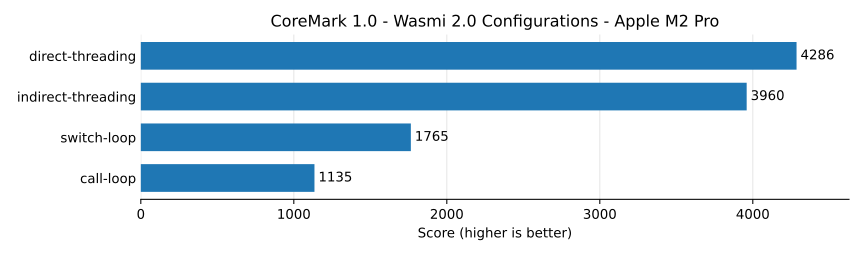
The project’s CoreMark chart compares the speed impact of Wasmi’s four instruction-dispatch configurations.
Open Source
Wasmi remains dual-licensed under MIT or Apache-2.0 and reports full WebAssembly specification-test compliance. The release’s most durable design lesson is not the headline multiplier but its explicit configuration choices: direct-threaded dispatch for maximum performance, indirect-threaded dispatch for a speed/memory balance, and switch-loop dispatch for platforms without tail-call support.
Linux & Self-Hosting
Self-hosted Artifactory operators should distinguish patch completion from incident closure. An upgraded instance is no longer vulnerable to this flaw, but the upgrade does not establish whether administrative access or artifact modification occurred beforehand. Review identity, token and artifact history; rotate exposed credentials when warranted; and validate downstream builds against trusted source and provenance records.
Newsletter Highlights
TLDR InfoSec’s September 2 edition surfaced the Artifactory issue, and TLDR DevOps surfaced Wasmi 2.0. The security status, affected branches, fixed versions, licensing and performance claims above were verified through JFrog, CISA and Wasmi’s original materials.
PKb Candidates
- Artifact-repository incident checklist: exposure, fixed branch, administrators, tokens, federation, recent uploads, altered artifacts, build consumers and credential rotation.
- WebAssembly runtime decision record: startup cost, steady-state speed, memory, deterministic execution, fuel metering, platform constraints, audit status and migration risk.
- Interpreter dispatch notes: direct-threaded, indirect-threaded and switch-loop designs with their portability and memory tradeoffs.
Trends Worth Watching
Artifact repositories are high-leverage infrastructure: administrative compromise can affect every consumer that trusts their contents. Vulnerability response should therefore include artifact-integrity and downstream-consumer analysis, not stop at upgrading the repository service.
Related PTIR Coverage
- Daily Briefing — September 1, 2026 — separating emergency patching from compromise investigation.
- Daily Briefing — August 22, 2026 — compromised Rust crates and supply-chain response.
Sources Consulted
JFrog’s official security advisory and release information; CISA’s September 2 alert and Known Exploited Vulnerabilities Catalog; Wasmi Labs’ release article, repository and package listing; selected technology newsletters; the latest PTIR edition; and read-only searches of the legacy recipient stream, Spam and Trash.